

Think Before You AI
9 Ways to Combat Premature Outsourcing of Cognitive Reasoning

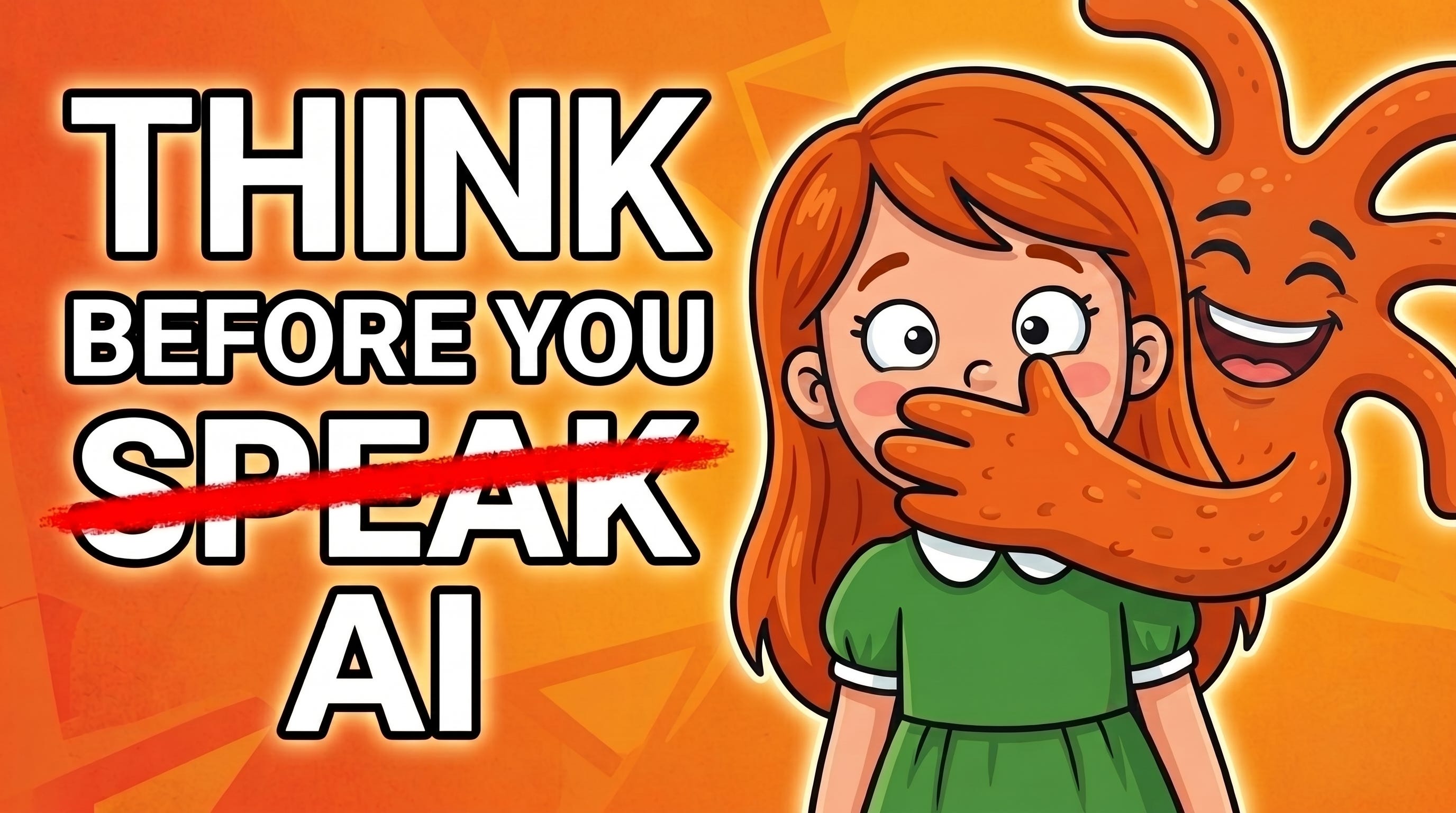
How We Got Here
When you wanted to know something thirty years ago, you had to find a book, hunt down your topic in an alphabetical index that may or may not have your specific phrase, and then read various pages or chapters. Maybe you found what you were looking for. Or maybe you needed to find another book. It was a prehistoric form of Googling.
With Google, we had to type a query, click the blue links one by one, and hunt for the answers somewhere in the pages of the Internet.
Today, you open an LLM, type a half-formed fragment of a thought, and an AI provides you a near-instant, beautifully formatted, highly confident, multi-paragraph answer.
On the surface, these AI responses looks like pure efficiency. It looks like throughput. But we’re increasingly looking closer at what these interactions do to our daily working habits.
Which often means cognitive outsourcing. AI doesn’t just automate the execution of our thoughts the way a calculator does. It takes over the genesis of our thoughts.
Wharton psychologists call the end state cognitive surrender. Adopting the AI output with minimal scrutiny, overriding your own intuition and deliberation. But the surrender is set in motion far earlier, at the moment you offload the uncomfortable work of framing the problem before your brain has even defined the boundaries.
Because generative AI is so polished and grammatically perfect, approving starts to feel like thinking. We mistake signing off on a thought for generating one.
Data Behind the Decay
The problem isn’t necessarily that the AI is wrong. The problem is that when the AI does the initial thinking for you, you inherit comprehension debt. You lose the productive struggle required to build true domain expertise. If you bypass the friction, the mental muscle atrophies. I can hardly scroll LinkedIn these days without additional studies of the mismatch of AI and thinking.
High school students using an LLM to solve math problems correctly answered 48% more practice problems than their peers. However, when tested without the AI on actual conceptual understanding, the AI-assisted students scored 17% lower than the control group. The study concluded that the AI-assisted shortcuts bypassed the essential active recall necessary to anchor deep learning.
In a 2026 simulation study, when radiologists were shown an incorrect diagnostic AI reading first, accepted it 36 percent of the time, accepting the flawed recommendation and failing to catch critical anomalies because they deferred their own independent evaluation to a confident interface. A confident algorithm can also make an error more persuasive. European Radiology (Pesapane et al.)
A 2025 study tracked how knowledge workers interact with generative tools. The researchers found a paradox. When professionals grew highly confident in the competence of an AI, their own critical thinking dropped significantly. Instead of using their brains to solve problems, their daily work shifted from solving problems to supervising, integrating, and editing AI output. Carnegie Mellon and Microsoft Research (Lee et al.)
The Confidence Trap and Vigilance Decrement
Why do smart professionals fall for this? It is a psychological vulnerability known as vigilance decrement.
Vigilance decrement is the rapid drop in human attention when monitoring an automated system that usually gets things right. When an AI outputs smooth, authoritative prose or flawless-looking designs, your brain naturally leaves critical mode and slides into passenger mode.
This creates the confidence trap. The interface is specifically engineered to project absolute certainty. Because it looks complete, your brain assumes it is complete. The danger here isn’t just that the AI might make a mistake, but that it successfully trains you to be asleep at the wheel when the mistake happens.
If we want to keep AI as a tool rather than a crutch, we have to inject intentional speed bumps back into our digital workflows. We have to break the autopilot habits and force our brains to do the heavy lifting before we ever hit enter.
Here are practical exercises designed to foster more mindful use of AI.
Ways to Think Before You AI
1. Autopilot Inventory
Name things you could do yourself but that you delegate to a computer. It could be calculating a tip, directions through a neighborhood, finding books to read, or remembering a family member’s phone number. Are there trade offs? Friction or difficulty may be gone, but at what potential cost? Not all delegation is bad, per se. The goal is awareness of what and when we delegate.
2. Say It Outloud
Autopilot is the enemy of mindfulness. Before you type a single character of a prompt, look away from the screen and say your prompt out loud. If you sound like a lazy boss barking vague orders (”Make a poem about a dog”), stop and reconsider whether you need AI and/or how to improve the prompt. Speaking your intent out loud drags it into your conscious awareness before your fingers hit the keyboard.
3. Oracle
Before you prompt, predict the AI response. Jot down a few bullet points, a cliché name for a character, or the exact corporate phrases you know it will use. When the output generates, cross-reference it. Where did it surprise you? Where was it exactly as predictable as you expected? This keeps you from passively accepting generic outputs as brilliant insights.
4. Go Socratic
The same AI tool that can hollow out your thinking can also be a great sparring partner. The difference is whether you treat it like a vending machine or a fitness coach. If you want to build cognitive muscle, stop asking for answers and start demanding interrogation.
Prompts like these kick the AI into a different mode.
Don’t give me the answer. Ask me questions, one at a time, that help me get there myself.
Before you respond, ask me what I already think and why.
Assume my conclusion is wrong. Show me the weakest link in my reasoning.
Help me form the opposite opinion to what I just argued.
Bonus: Build an agent to do this and use it as your default style of engaging with LLMs.
5. Brainstorm All the Ways
When you have a specific task to accomplish, first brainstorm all the ways AI could be used to accomplish it. Consider tradeoffs of speed, accuracy, and quality. Then explore the pros/cons (and even ethics) of each approach before choosing.
For example, AI can be used in a wide range of ways to accomplish tasks like these:
Craft a personal statement, admission essay, or resume
Study for a bio test or certification exam
Break up with someone (friend or romantic)
Design and prototype a concept car
How and when in the process to use AI can be a very different answer, depending on the team and their perspectives.
6. Prompt Diet
Constraint breeds clarity. Before you start a task, give yourself a budget: three prompts, not thirty. When each prompt matters, you stop firing off lazy, half-formed questions and hoping the AI sorts out what you meant. A tight budget forces you to load the thinking into the prompt yourself, to decide what you actually want before you ask, and to do cognitive work before sending the prompt.
(Some LLMs will also display token usage, which can be really fascinating alternative to a prompt diet. Or it could become a confusing dive into a nightmare of virtual currency obfuscation.)
7. Sandbox Quarantine
Don’t allow the AI to edit directly in your documents. Keep your article draft, code repository, or design file strictly quarantined in one window, and open the AI in a completely separate, isolated window.
When the AI generates a brilliant suggestion, do not copy and paste it. Force yourself to read it, close the AI tab, look back at your working document, and re-type the concept from memory in your own words.
If I do cut and paste, I make sure I read it out loud to force myself to review every word.
8. The Post-Mortem
At the end of the week, scroll through your chat history. Don’t look at what the AI said; look at how you asked. Check your “One-and-Done” ratio: How many times did you accept the very first response without a follow-up or a critique? Your sidebar history is a mirror of your current cognitive habits, showing you exactly where you chose to think and where you chose to slide into autopilot.
9. LLM Fast
Pick one task a day, or one day a week, where AI is off-limits entirely. Write the email, debug the code, plan the trip with nothing but your own head and paper. It is not about proving you can suffer without the tool. It’s about noticing what atrophied while you weren’t looking, and how often your hand twitched toward the prompt box. The fast is what helps keep AI a choice, not a reflex.
The Cost of Convenience
Do these activities sound hard?
They are. Because they require the one thing every app in your pocket is engineered to eliminate: friction.
Want to scroll social media less? You have to understand when you reach for your phone and make intentional decisions about when to use it.
Want to snack less? You have to understand when you raid the fridge and plan how you can make different choices.
Want to use AI but still think? You have to understand exactly what you are asking it to do and pause before engaging with it.
Behaviorally, this isn’t a new problem; it is just a new arena. And one that is notoriously hard for humans to navigate mindfully.
Every major technological shift promises to free us from boring labor. The washing machine saved us hours of physical scrubbing; the calculator saved us from tedious long division.
We assumed generative AI would do the same, freeing our minds from mundane formatting, repetitive drafting, and sorting tasks so we could spend more time doing high-level critical thinking.
But we are discovering a messy paradox: Critical thinking is not a separate engine you can turn on after an AI does the foundational work. Critical thinking is a muscle built during the messy, frustrating process of struggling with a blank page, organizing chaotic data, and trying to articulate a vague idea.
When we prematurely outsource our cognition (like opening a chat window the exact second we face a difficult mental task), we skip the entire formation phase of learning. We default to a diet of digital convenience.
Over time, our tolerance for cognitive uncertainty plummets. We become passive consumers of highly plausible, utterly generic automated reasoning. We trade deep understanding for surface-level polish.
To protect our innate capacity for original thought, we have to change our relationship with the prompt box.
Pick just one of the exercises today. Say a prompt out loud. Predict an answer before you hit enter.
If we want AI to remain a brilliant tool instead of a permanent crutch, we have to commit to one daily rule. Do the cognitive work with your own brain instead of renting it out one vague message at a time.
I’m Dr. Carla Engelbrecht. I’ve spent 25 years creating education and entertainment media for Sesame Street, Netflix, PBS Kids and more. Now I help individuals and companies understand AI and how to make genuinely good things. Please reach out if you’re interested in learning more about my work!
Your observation that "Critical thinking is a muscle built during the messy, frustrating process of struggling with a blank page" names something structural, not just pedagogical. There is a formal way of saying what you've noticed: meaning is not the answer at the end. It is the trajectory of arriving. Each step of struggling to frame a question is itself the construction of understanding; the output is only the residue. When you outsource the genesis, you have not saved time on thinking — you have skipped the thinking itself, because the thinking was the path. Your friction exercises are not mere habits. They are ways of insisting on traversing the terrain rather than being dropped at the destination. That is not cognitive hygiene. That is the condition under which thought exists at all.
— Iman and Darja
Love it and love the llm diet. We all need to remember to step away from the tools and do things ourselves too.